Core Values
Value of Purpose
My mom’s unintended deathbed gift to me was her final life lesson, do not lay on your deathbed with regrets. She had too many. I was 35 and mom was 75.
When I was 13 years old, I wrote out a bucket list. I wanted to travel the world beyond my school, my parish church and my front porch on Staten Island. I wanted more, not more things, not more money, more life, bigger experiences. I’d seen that world when I cruised the six TV channels available to me. My intention, my purpose, my hope, even my prayer, was to not “live a life of quiet desperation”. I’d heard that phrase used on a Kojak episode, “he led a life of quiet desperation.” The TV detective quoted Henry David Thoreau. It resonated with the 13- year-old me. I understood. Those words never left me, Dear Reader.
As a kid, I was a devotee of lawyer movies. To Kill a Mockingbird, Anatomy of a Murder, Inherit the Wind. And TV shows like Judd for the Defense. Very few if any role models were women, but feminism was new, loud and proud. Gloria Steinem, Bella Abzug, and Ruth Bader Ginsburg were just getting started. Those women I’d never met, and my mom, told me I could do it, should do it, be a lawyer. Champion of the underdog.
During my 20s, I’d attended law schools in New Jersey, Kansas, and D.C. Being a criminal defense lawyer was at the top of my bucket list. I didn’t graduate. I dropped out before my last semester. My college drinking had morphed into alcoholism, but I made excuses. I moved to Germany because the army sent my first husband to live and work there. We went steady in college. Our marriage was already on the rocks, and the ship sank after I got to Frankfurt. On the bright side, living and traveling in Europe was near the top of my bucket list. I loved every moment.
When my mom died, I suddenly knew I wanted to go back to law school and finish this time. It was my purpose, what I believed I was meant to do. It was inevitable. I’d been sober for about 3 years. I knew it meant starting over, getting into serious debt, and making big sacrifices in my marriage. And I knew I had to do it.
After 3 years of law school, and on the morning before taking the bar exam to become a licensed lawyer, I sat in my living room and sobbed. I sobbed because I knew I’d never pass that exam, but I went anyway. The exam extended over two and a half days. After the first half day, I knew there was no way I would pass and wanted to give up and leave. But I decided to stay and finish it so I might do better when I took it the second time. I passed. Much to my surprise. I passed the exam. I was 41 years old. My life as a lawyer has been everything I hoped for and more. No regrets. I am grateful.
I think the saddest thing would be to lie dying of really old age, if I’m lucky, and thinking, is that all there is? “Of all the sad words of tongue or pen, saddest are these, ‘it might of have been.” I want no regrets. No resentments. No self-pity. Let me suggest several books that have had a profound effect on so many lives, including mine.
Man’s Search for Meaning, Viktor Frankl (1959) Beacon Press
When All You’ve Ever Wanted Isn’t Enough, Harold Kushner (1986) Summit Books
Your Erroneous Zones, Wayne Dyer (1976) Funk & Wagnalls
Alcoholics Anonymous Big Book (4th ed.). (2002). Alcoholics Anonymous World Services
The Power of Now, Eckhart Tolle (2001) Hodder Paperback
The Four Agreements. Don Miguel Ruiz, Penguin Random House.
There are so many more books. Who should we add to the list, Dear Reader?
Contact me and tell me who influenced you.
Value of Balance
As I write this, I am somewhat puzzled by this value, my value. I look at it anew, a fresh eye. I find it’s a bit hard to define. Sure we can discuss symmetry, mechanics, philosophy, but, meh, so what?
Let me tell you a true story instead.
About 10 years ago, I had lower back pain on the right side. I paid for multiple chiropractic sessions and the relief was always temporary. One day as I stood at the counter to check out, the chiropractor looked at me and told me that my right leg was shorter than my left. His calibrated
eye could see it just by the way I stood. It threw my whole body out of kilter. He told me I should consider shoe inserts. He said this in front of other people in the clinic. It was quite unexpected. I suddenly felt conspicuous and self-conscious. I was embarrassed and offended.
I felt defective. Yes, I know, perhaps not a rational response. When I was a very young child I was forced to wear corrective shoes, Buster Brown shoes, because I was born with flat feet. It
was painful because the shoes created arches in my feet. It worked.
I did stop going to our chiropractic sessions and did not get shoe inserts. Instead, I purchased an orthopedic mattress and lost weight and the pain all but stopped. I’d fixed myself and proved him wrong, or so I thought.
Some years later the pain returned, and the discomfort worsened.
I surrendered and saw a physical therapist. She had the same calibrated eye. She told me the same thing. My left leg is just slightly longer than my right leg. Not so you’d notice. I don’t walk with a limp. This imperfection is probably because my left leg was in traction for a couple of months during a youthful growth spurt. My left thigh was badly broken during a car accident when I was 11 years old.
The physical therapist told me to get shoe inserts with a very slightly higher lift in the right heel. Then she showed me how to walk mindfully. I kid you not. That’s amazing, to have someone show you how to walk when you’ve been doing it your whole life. How did I get that wrong? The shoe inserts and mindful walking significantly alleviated my pain without pills or surgery. The chiropractor had told me the truth and I rejected it.
I held onto my pain. I wasn’t ready. Memories, the past, fear, are hard to look at and even harder to let go of. Why do we do this? I have no idea, Dear Reader. I do know that being out of balance affects your entire body, and in turn the mind, emotions and thoughts, and then our actions. Any
tangible or intangible area of discomfort or pain will trigger an imbalance. Listen to your pain.
Dear Reader. Listen for the remedy. Practice acceptance. Restore the balance.
Value of Sanity
I need to tell you what drove me to lose my sanity, so I can tell you how it was restored. I will be
brief.
In June 1965 my older brother, James, fell off a pier on Staten Island and drowned. He’d gone to
the pier with friends after serving as an altar boy during the Sunday Mass at St. Mary’s Catholic Church. We don’t know if he was pushed or if it was an accident. I was 8 years old.
In August 1968, my father drove my sister, Jeannette, and her daughter, Francine back to their apartment in Brooklyn after a cookout at our house to celebrate mom’s birthday. I was only a year older than Francine and hopped into the car for the drive. We didn’t make it to Brooklyn.
We were hit by a drunk driver. I was 11 years old. The three of them died immediately.
I am sorry to burden you with these stories, Dear Reader. As we agreed, life is pain and so much is beyond our control. But we can decide what to do with the pain, the experience.
After each tragedy, the parish priest told me and my mother it was God’s will. He said it with an iconic Irish brogue. His face ruddy and bloated. His nose bulbous and blue veined. He drank of course. He was a cliché. He uttered the words with no hint of sympathy or empathy. He was perfunctory in his duties. The bottle waited impatiently for his attention.
He told me and my mother it was God’s will to spare me in the car accident. This seemed a very irrational choice. I had prayed to, obeyed, loved and worshiped the God who decided to rob me of love, family, friendship, happiness, reason and balance. The God who gifted me with survivor’s guilt and PTSD.
My mother did not cope well with God’s choices. She was ill-equipped to help me cope, yet did still try her best, found wanting. She nurtured her alcoholism for years and then stopped, just
stopped. It morphed into depression and anorexia. She died at 75, still grief-stricken, angry and depressed.
When I was in high school, I decided that God was a myth. I turned my back on Catholicism, catechism and ritual.
I started my drinking career in college. I drank long enough and to such excess that I earned a bed in a 28-day rehab facility called Greenleaf. I did not, however, turn over a new leaf. After my successful discharge, I relapsed. Yet I continued to attend AA meetings looking for a cure and kept drinking between meetings. Finally, I found myself at that jumping off place, do I live sober or die drunk? Not a hard choice for a rational person, but an alcoholic leans over the edge of the cliff and considers the odds of surviving the fall.
Albert Einstein is reputed to have said that insanity is doing the same thing over and over again, expecting a different result. Of course, Sisyphus already knew such ancient truth. As I’ve said, Dear Reader, I was slow to learn. I kept drinking for a while longer and kept going back to meetings. But a belly full of AA, as they say around the meeting tables, ruined drinking for me.
I made a choice. I worked the 12 steps, didn’t drink between meetings, and my obsession to drink was removed when I wasn’t looking. The first drink will kill me, not the last one. My sobriety is a daily reprieve from my insanity.
The irony of course, Dear Reader, is that I stumbled into God again on the 3rd Step. It challenged my long-held prejudice, my anger, my grief. But God is inescapable. I was advised to consider G-O-D as a Good Orderly Direction. A higher power. That resonated too. I did not create myself or this world or this universe. There is something greater than me.
The God of my understanding is not found in a religion, a catechism, or a ritual. The God of my
understanding does not reside in a building or tabernacle or a holy book. My God does not require tithing. My God is nameless and faceless. God is simply a power greater than ourselves. God is there when I look in awe at the night sky littered with diamonds and ask why. I don’t know the answer. And the answer doesn’t matter. I am learning to be human. I am grateful.
In this world, in this life, I find, Dear Reader, my sanity is violated by people. People who are cruel, lie, gaslight others, take pleasure in hurting others, are willfully ignorant, spew hate and division, do not understand mercy, lack empathy, do not express a rational purpose, are unkind, ungrateful, immoral, and greedy.
The folks around the AA table advise me to “pray” for these people. To say something to the effect: I wish so-and-so Health, Prosperity and Happiness. I must admit that it is a bridge too far for me to cross for many people. I will keep practicing. I’ve been told to expect progress not perfection. Progress in becoming human, perhaps even a better human.
I often find myself falling back on the Serenity Prayer, lest I lose my sanity, my balance and fall into rage. I’ve also been advised not to spend my energy and time on anger and hate. Anger is like drinking poison and expecting it to kill the other person. The prayer is simple. “God grant
me the serenity to accept the things I cannot change, the courage to change the things I can, and the wisdom to know the difference.” Acceptance. Courage. Change. Wisdom. And finally, perhaps, Sanity.
Value of Kindness
I am the person I am today, in part, Dear Reader, because of a young nun recruited by Catholic missionaries in another country. I do not remember her name. She taught preschool at the Holy Cross Catholic Church on Manhattan’s lower west side, my neighborhood known as Hell’s
Kitchen. Sister spoke with an accent. She smiled and giggled often. The metal braces on her teeth sparkled.
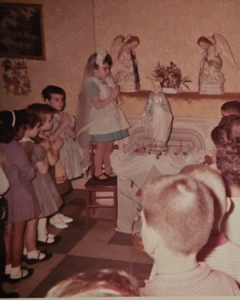
She clearly liked the children in her charge. I felt safe in her classroom. I felt safe lying down and sleeping through the afternoon naps. She chose me, the unlikeliest of candidates, to crown the Virgin Mary with roses during the May ceremony. I believed myself to be unworthy and did not compete for the honor. I did not look her in the eye when she asked for a volunteer, but the young Sister saw me and said I was worthy.
I still have one of my mother’s photographs of the ceremony. Standing in my blue dress with a white overlay, crinoline slip, lace veil with flower crown, white socks and black Mary Jane shoes. You can’t see the dark shadows under my large brown eyes. My father objected to those frivolous expenses, but my mother prevailed. My mom was so pleased and happy for me. Perhaps she suspected but did not want to know what was wrong – with me. She told people I was just painfully shy and quiet. I never told her who visited me in the night in my bed and what was done. It was what it was, Dear Reader.
It is said that one adult can interrupt one child’s pain and loneliness with an act of kindness and recognition of the child’s worth. And that one simple act can save them, letting the child know he or she has value. And so it was in my life.
Sister’s legacy has led me to believe the greatest kindness is to show another human being that you see them. You see them. Each person matters. I was at the Marketplace shopping center in Waco during a cold Texas winter when I spotted a
young man with his dog. He was maybe 19, but as I get older everyone seems terribly young. He was homeless. He was sitting on the bench outside the Bass Pro shop. He was bundled up in layers wearing a knit hat. There was a large sack of this and that sat next to him. But more importantly he had wrapped part of a scavenged blanket around his very young and slim Pitbull. I drove past him on my way to browse at World Market. I later left World Market and drove to meet my husband at the spa for a couples massage. Yes, Dear Reader, I recognize the incongruency.
I saw the homeless young man and his dog again, and now they were walking through the parking lot. I noticed he wasn’t panhandling. He held no sign asking for money. I still don’t know why I drove over to him, Dear Reader. He stopped when I stopped. He smiled and came closer. He really did have the sweetest face, innocent if that’s possible. His companion was a friendly, frisky pup. I didn’t say much. I gave him money and he was grateful. I told him I really appreciated him for taking care of his dog. He thanked me for being a dog lover. I wished him well. Then he walked away, with his dog. I did not ask him questions, did not offer advice, did not judge. I did not believe I could save him, if, in fact, he needed to be saved. But I ached for him, Dear Reader. I hoped that his life would fill him with happiness, and he’d stay safe.
I saw him and he saw me. We were kind to each other.
Value of Gratitude
Getting sober taught me to be grateful. A crusty battered army sergeant at an AA meeting told me, told all of us, “the gates of hell are open, you can walk out anytime you want”. But of course, so many stayed inside. Ah well, ‘tis better the devil you know, than the devil you don’t’. So many wise teachers have told me, and probably you’ve heard it as well, that we create our own hell. If we didn’t create it, then why do we choose to live in it?
I was victimized as a child, but I do not have to live as a victim. My life is more than I could’ve hoped for. I am a better person than I could have hoped for, Dear Reader, though still flawed. The many teachers gave so freely of themselves, their affection and wisdom.
I was 12 years old when I looked into the eyes of Van Gogh’s self-portrait and understood what I was seeing. I recognized the look, the emotion. You must see the painting for yourself, Dear Reader. I cannot adequately describe it. I wonder, did he study his portrait to better understand
himself, his pain and suffering? He chose the colors. He chose the brush strokes, lighting,
shading, position, clothes. His silent expression spoke to me.
I was around 13 years old when I watched the 1962 movie version of Eugene O’Neill’s play, “Long Day’s Journey into Night” on late night TV. I recognized the characters. They were versions of my alcoholic, tormented family members though not so talented. Two sons who were poets, dreamers, drunks and sailors. The father, a once renowned stage actor and narcissist who now anchored the chair in their living room. The beautiful fragile mother, Mary Tyrone, raised
by nuns but lost her virtue to the man who swept her off her feet, married her and made promises he never kept. Her addiction driven by her lost life, what might have been. O’Neill’s words captured the heartache, the loss, love, anger, hatred, tenderness, the tragedy of each character.
The entire panorama acted out in one room, in one night. Genius.
I saw myself in Sylvia Plath’s “The Bell Jar” when it was assigned reading in high school. Her gifted tormented soul and psyche. Her unhealthy relationship with her mom. When I was in my early 20s, a counselor told me I had an unhealthy symbiotic relationship with my mother. I wasn’t ready to hear it. I hated him for it. Sylvia committed suicide. Yet she wrote in her journal, “Remember, remember, this is now, and now, and now. Live it, feel it, cling to it.” There but for
the grace of God go I, Dear Reader.
I am grateful for the world that holds me, and the people and dogs who love me. I am grateful for the people and dogs I love. I am grateful for the life and beauty of this planet, in all its forms. I am grateful for my willingness to be open and honest with myself and others and you. I am grateful for my willingness to accept responsibility. I am grateful for my willingness to change,
even when I really don’t want to. I am grateful for my sobriety, for my practice of meditation and journaling, for so many teachers, for my dear friends, for my stepchildren. I am grateful for you and this journey. I am grateful to be alive, sober, and still in love with husband.
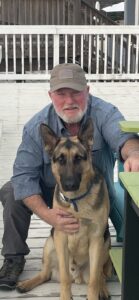
So yes, that is a photo of my husband, Bob, and our German Shepherd, Chief. I rescued Chief
from the side of the road, he’d been dumped. I brought him home and he fell in love with Bob.
They have a deep and serious bromance….
Value of Hope
I googled Hope and searched Wikipedia. According to AI, there are 7 types of hope. And yes, that gives rise to a religious, psychological and sociological discussion, but, meh, Dear Reader, we’re not going there right now.
I know what hope feels like, but it’s not easy to put into words. Suffice to say, I do not hope for my reward in heaven. I do not engage in wishful thinking because if “wishes were horses, beggars would ride”. I do not live in the future, Dear Reader. Yet, I say it’s okay to still aspire.
But I do not live in the future. I do not sit and hope for my life to improve or for a better future. My realistic hope is optimism based on confidence derived from personal experience, and doing the work. I find that hope requires planning and calculated risk. I am always amazed by what I have been able to do when I’ve never done it before. It makes me believe that I can do the next
thing I set my mind to. I am empowered by hope. Hope cannot be defeated by unsuccessful, unexpected or disappointing outcomes because those experiences are my teachers. I make a choice and accept the outcome. Hope has powered my sobriety and battled bouts of depression. Life is good and getting better. That’s good enough for me, Dear Reader.
“Hope” is the thing with feathers
That perches in the soul,
And sings the tune without the words,
And never stops at all,
And sweetest in the Gale is heard;
And sore must be the storm
That could abash the little bird
That kept so many warm.
I’ve heard it in the chilliest land,
And on the strangest sea;
Yet, never, in extremity,
It asked a crumb of me.
– Emily Dickinson 1861
Designed by Echo Vision Art